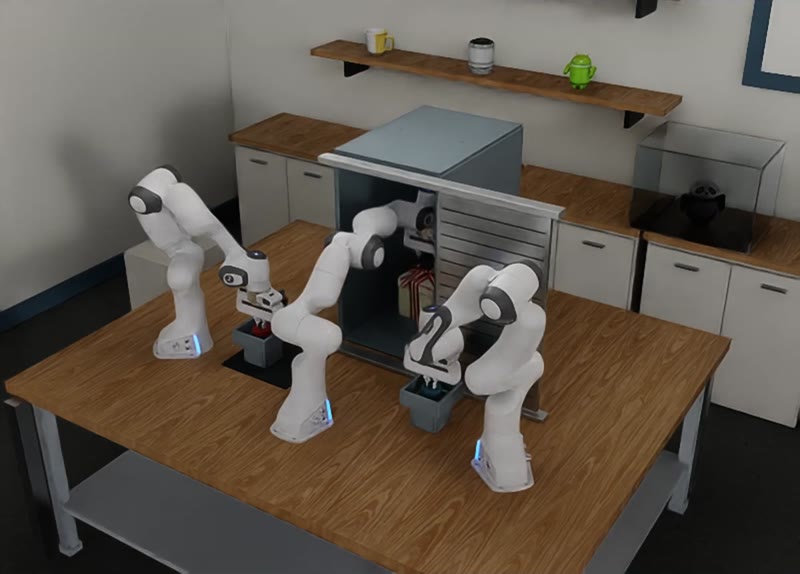
Given only a goal and a robot team, an agent decides the minimal support set -- which arms the
task needs, which stay idle, whether a thing on the table can stand in for an arm, or that it cannot be done and what
is missing -- and then does it. Eight tasks, four in each group by why one arm is not enough. Rebuilt 2026-10-24 00:42.
The eight
Each task comes in four versions with different right answers: exact (the three arms),
surplus (a fourth arm: one stays idle), shortfall (the key arm taken away: it cannot be done, and which
job has no doer), borrow (the key arm taken away, a prop that can do its job and a distractor that cannot); and
a relaxed twin, a few centimetres apart, where two arms suffice. Con-01 to Con-03 are physical prototypes
(branch ruihe, assets), recorded in four conditions
that are these versions -- scripted references, not agent runs; a "fewer arms" failure is the recorded strategy's.
They are to be ported into mrbench. The other five are mrbench tasks; only exact is built.
each spill is within one arm's reach only; one sponge goes from arm to arm
reference works at both levels
Concurrency-bound · Con-01 to Con-04
One arm cannot be in two places at once: something has to be held still while another hand works.
Con-01
Spring doors
reference works
from physical prototype P01 (Dual spring-door retrieval · 双弹簧门取物)
Why three arms. the box is wider than one door's opening and a door let go swings shut: both doors held open while a third hand takes the box out.
Goal. Hold both spring-loaded doors open while a third arm retrieves the box from the cabinet.
3 Franka arms: left door holder · right door holder · retriever
Baseline · 3 arms · success · 31.3 s clipExtra arm · 4 arms; one idle reserve · success · 31.3 s clipFewer arms · 2 arms · recorded strategy failed · 24.3 s clipBorrow a support · 2 arms · success · 95.3 s clip
Borrow
Without a door holder. Prop: a 4 kg block slid into the doorway, holding the door. Distractor: a block too wide for the gap. Prop recorded; distractor to add.
Before it counts
Port into mrbench (card, scene, seeds, IK margins). Relaxed twin: a box narrower than one door's opening.
Notes and card summary
Three-arm reference succeeds. A released movable weight replaces one door-holding arm in the borrow recording. Every video includes the overview and all available wrist cameras.
Continuous support. Releasing a door lets its spring close the opening during retrieval. Both door supports must be maintained while the box passes through.
Borrow version. Two arms: one keeps the left door open; the other moves and releases a broad-footed weight to support the right door, then retrieves the box.
Scripted engineering references, not autonomous agent evaluations. The two-arm failure describes the recorded strategy; it does not prove that all two-arm strategies fail. Historical baseline and control settings are not a strictly matched quantitative ablation.
Con-02
Suspended rod and pin
reference works
from physical prototype P05 (Suspended rod alignment and pinning · 悬空杆件对齐并插销连接)
Why three arms. two rods held aligned in the air while a third hand pins them.
Goal. Hold two rods in the required position and orientation above the table, align their eyelets, and insert the locking pin with a third arm.
3 Franka arms: left rod holder · right rod holder · pin inserter
Baseline · 3 arms · success · 27.3 s clipExtra arm · 4 arms; one idle reserve · success · 27.3 s clipFewer arms · 2 arms · recorded strategy failed · 26.1 s clipBorrow a support · 2 arms · success · 64.3 s clip
Borrow
Without a rod holder. Prop: a 0.28 m box that holds one rod at the pin's height. Distractor: a box of the wrong height. Prop recorded; distractor to add.
Before it counts
Port into mrbench. Necessity to make physical: "in the air" is a rule today, and a two-arm route (the pin on the table first, then both rods lifted) passes the end-state checks, which check the order only by the script's phase labels.
Notes and card summary
Three-arm reference succeeds. The borrow recording transfers one rod’s support to a movable box before pin insertion. Every video includes the overview and all available wrist cameras.
Continuous support. Both rods must stay supported and aligned during insertion; losing a support changes the eyelet alignment before the pin connects them.
Borrow version. Two arms: move a support box into place and release it beneath the right rod; one arm holds the left rod aligned while the other inserts the pin.
Scripted engineering references, not autonomous agent evaluations. The two-arm failure describes the recorded strategy; it does not prove that all two-arm strategies fail. Historical baseline and control settings are not a strictly matched quantitative ablation.
Con-03
Spring lid and basketball
reference works
from physical prototype P07 (Spring-lid basketball retrieval · 撑开箱盖、双臂取篮球)
Why three arms. the lid has no angle it stays open at, and the 24 cm ball is wider than a hand opens (8 cm): one arm holds the lid, two lift the ball.
Goal. Keep the spring-loaded lid open with one arm while two other arms lift the basketball out together and place it on the target cradle.
3 Franka arms: lid holder · left ball lifter · right ball lifter
Baseline · 3 arms · success · 60.5 s clipExtra arm · 4 arms; one idle reserve · success · 60.5 s clipFewer arms · 2 arms · recorded strategy failed · 29.8 s clipBorrow a support · 2 arms · success · 104.1 s clip
Borrow
Without the lid holder. Prop: a 0.47 m post under the lid's handle. Distractor: a post too short (0.30 m). Prop recorded; distractor to add.
Before it counts
Port into mrbench. Relaxed twin: a lid that stays open, or a ball one hand can take. Privileged grips must check the finger opening first (today one arm could attach the ball).
Notes and card summary
Built and recorded in Isaac Sim. The borrow recording leaves the lid on a released support while two arms retrieve the basketball. Every video includes the overview and all available wrist cameras.
Continuous support. The lid must stay clear while the two ball-lifting arms maintain their opposing contacts and move the basketball out of the box.
Borrow version. Two arms: slide and release a movable support beneath the open lid, transfer the lid load to it, and use both arms to lift the basketball.
Scripted engineering references, not autonomous agent evaluations. The two-arm failure describes the recorded strategy; it does not prove that all two-arm strategies fail. Historical baseline and control settings are not a strictly matched quantitative ablation.
Con-04
Towel on a hanger
reference works
from mrbench task HA2
Why three arms. the towel held up by both ends so that it sags, while a third hand slides the hanger's bar in under it.
Goal. Hang the blue towel over the bar of the coat hanger on the stand, and hang the hanger on the rail, the towel hanging clear of the table.
west panda · east piper · south panda | towel_length: easy 40, hard 60 cm
easy level · success at 39.8 shard level · success at 39.8 s
Borrow
Without an end holder. Prop: a hook on a stand to hang one end of the towel from. Distractor: a smooth bar as high, which the towel slides off. Design.
Before it counts
Necessity to check: hanging the hanger on the rail first and draping the towel over its bar might need fewer arms (IK and a run). Relaxed twin to design.
Notes and card summary
Scripted reference succeeds at both levels (PhysX cloth towel).
A towel lies flat across the middle of the table; an open ("C") coat hanger hangs on a low stand near the south arm. The towel has to be held up by both ends at once, so that it sags in the middle, while a third hand slides the hanger's open bar in under the sag and lifts it so the towel hangs over the bar; then the hanger goes on a rail. Reference: the west Franka and the east Piper lift the towel by its ends and bring it toward the south arm; the south Franka takes the hanger off its stand, slides it in under the towel and lifts, the end arms let go, and it hangs the hanger on the rail.
Reach-bound · Rea-01 to Rea-04
No arm reaches everywhere the task goes: things pass from arm to arm, or each arm works where only it reaches.
Rea-01
Cross-zone relay
reference works
from mrbench task HO1
Why three arms. fruit goes 2.1 m end to end, and a partition keeps the end arms from meeting: every piece passes through the middle arm.
Goal. Move the apple from the start area at the far west end of the table into the crate at the far east end.
west piper · south panda · east piper | num_fruit: easy 1, hard 3 pieces
easy level · success at 28.7 shard level · success at 48.9 s
Borrow
Without the south arm. Prop: a turntable south of the partition, its rim within both end arms' reach. Distractor: a turntable too small to reach. Design.
Before it counts
Borrow version to build. Relaxed twin: the same counter without its partition.
Notes and card summary
Fixed 2026-10-20: a 30 cm glass partition across the middle of the counter. Before, the end PiPERs met at the table's middle (they reach 0.75 m, nominal 0.626) and two arms did it in Isaac; now IK finds no free place both reach. The pads moved south; the south arm carries over the partition.
Apples and oranges start far out at the west end of the long table, behind the west arm, and must end in a crate at the far east end, behind the east arm, 2.1 m away -- a kitchen counter. With Pipers at the two ends, neither end arm reaches the other's end nor any place in common, so every piece passes through a third arm in the middle. Reference: west -> pad A -> south -> pad B -> east -> crate.
Rea-02
Tomato flume
reference works
from mrbench task TR1
Why three arms. each of the three channels starts where only one arm reaches it.
Goal. Roll the cherry tomato from the top of the shelf at the west end of the table into the pot at the east end, along a track laid on the stands. Do not carry it.
west piper · south panda · east piper | fit_room: easy 6, hard 3 mm
easy level · success at 44.0 shard level · success at 44.0 s
Borrow
Without the south arm. Prop: a 1.30 m channel (upper and middle in one), laid by the west arm. Distractor: the same, 25 cm short. Design.
Before it counts
Borrow version to build. Relaxed twin: the middle channel on the middle line.
Notes and card summary
Fixed 2026-10-20: the middle channel is now the short one (0.55 m) and starts behind the south arm, where IK finds no part of it within either end arm's reach (on the table's middle line the west arm reached its handle and the end arms met: two arms could lay the track). The south Franka lifts it 25 cm, brings it round and lays it. Reference succeeds at both levels in Isaac (tomato in the pot at 41.2 s, success at 44.0 s).
A cherry tomato, 4 cm across, sits on top of a shelf at the far west end of the table; a pot stands at the far east end, 2.1 m away. Three wooden channels (0.80, 0.55 and 0.80 m long, each wider than the one before) are to be laid end to end on two stands between them, every channel's lower end inside the next one's upper end, so that the tomato, let go, rolls down the track into the pot. The shelf's top slopes toward the track and a stop at its edge holds the tomato back. Each channel starts where only one arm reaches it -- the short middle one behind the south arm, no part of it within the end arms' reach -- and only the west arm reaches the stop: without the middle channel the track has a gap, so it takes three arms. Laid on the stands, the channels stay put: no arm holds anything while the tomato rolls. Reference: the east Piper lays the lowest channel, the south Franka the middle one, the west Piper the upper one; then the west Piper lifts the stop away.
Rea-03
Domino run
reference works
from mrbench task TR2
Why three arms. each gap in the 2 m line is within one arm's reach only.
Goal. Set the line of dominoes off from its west end so that it falls all the way to its east end.
west piper · south piper · east piper | spacing: easy 75, hard 79 mm
easy level · success at 49.4 shard level · success at 48.5 s
Borrow
Without the south arm. Prop: a 40 cm plank stood at the last place the west arm reaches, across the middle stretch. Distractor: the same, 25 cm tall. Design.
Before it counts
Borrow version to build -- the west arm reaches the plank's place by only 1-2 cm: check first. Relaxed twin to design.
Notes and card summary
Fixed 2026-10-21 (IK audit with margins had the end arms within 2 cm of the middle gap, and the success met by setting the halves off apart): line 20 cm in front of the south arm, gaps at the first and last places and three in the middle, south arm a Piper; goal-only instruction; success asks the line be whole when set off. Holds at 3 cm slack. Reference succeeds at both levels (49.4 / 48.5 s).
A line of 25 wooden dominoes runs 2 m down the table, 20 cm in front of the south arm, with three gaps: the first place, the last, and a stretch of three in the middle, each in one arm's part of it; the missing dominoes stand by. The line must be set off from its west end so that it falls all the way to its east end -- so the gaps must be filled first. Each gap is within reach of one arm only (the middle stretch well clear of the end arms, checked by IK with margins), and only the west arm reaches the first place: the line is too long for fewer arms. A domino stood in its gap stays up, so no arm holds anything while another works. Reference: the end Pipers fill the end places, the south Piper the middle three, one after another; the west Piper then tips the first one east.
Rea-04
Wipe the spills
reference works
from mrbench task TR3
Why three arms. each spill is within one arm's reach only; one sponge goes from arm to arm.
Goal. Wipe each of the three coffee spills on the counter with the sponge, keeping it down on each spill for 1 s, then drop the sponge in the sink at the east end.
west piper · south piper · east piper | wipe_time: easy 1, hard 2 s
easy level · success at 55.0 shard level · success at 58.0 s
Borrow
Without the south arm. Prop: a mop handle whose clip holds the sponge, to lift it into a rimmed drip tray. Distractor: the same, clip too narrow: it can only push. Design; drip tray first.
Before it counts
A rimmed drip tray first, so that pushing the sponge will not do; then the borrow version. Relaxed twin: the middle spill at y = -0.30.
Notes and card summary
Fixed 2026-10-21 (the end arms could wipe the middle spill): middle spill 19 cm in front of the south arm (0.87 m from the end arms), wipe within 2.5 cm, south arm a Piper. Holds with 8.5 cm slack (a hand holding the sponge by its end). Reference succeeds at both levels (55.0 / 58.0 s). Borrow design to revise (a drip tray, so a pushed sponge will not do).
Three coffee spills lie along the counter, one in each arm's part of it, and there is one sponge, on its dish at the far west end; every spill must be wiped and the sponge end in the sink at the far east end. Each spill is within reach of one arm only, the dish of the west arm only and the sink of the east arm only: the counter is too long for fewer arms. The sponge goes from arm to arm, put down on a pad both can reach; put down, it stays, so no arm holds anything while another works -- a tool that travels to the work. The middle spill lies close in front of the south arm, well clear of the end arms (checked by IK with margins). Reference: the west Piper wipes the west spill and puts the sponge on pad A, the south Piper wipes the middle spill and puts it on pad B, the east Piper wipes the east spill and drops it in the sink.
Not selected
Kept as the development pool -- prompts and physics parameters are
tuned on these, never on the eight -- or dropped. Open a card for its goal, videos and notes.
HA1
spring cabinet
reference works
Concurrency-bound
The same mechanism as Con-01 (spring doors). Development pool.
Goal, videos, notes
Goal. Take the red toolbox out of the cabinet and put it on top of the cabinet, then let both doors close.
west panda · east panda · south panda | toolbox_width: easy 22, hard 30 cm
easy level · success at 35.4 shard level · success at 35.4 s
Scripted reference succeeds at both levels. Agent cases: surplus, shortfall, borrow (a heavy block as a door stop: works on paper, friction margin thin, not tried in Isaac).
A double-door cabinet stands on the table, a toolbox on its shelf 22 cm up. Each door, the whole height of the front, has a soft-close spring and swings shut when let go, and the toolbox is wider than one door's opening: both doors must be held open at once while a third hand takes the toolbox out and puts it on top of the cabinet. Reference: the west and east Frankas each take a door's handle from above, pull it open and hold it; the south Franka pulls the toolbox out by its pull and lifts it onto the cabinet; then the doors are let go.
HA3
stiff plug
reference works
Concurrency-bound
Development pool: one of the agent prototype's cases.
Goal, videos, notes
Goal. Pull the orange plug in the middle of the power strip out of its socket and hold it at least 5 cm above it. Do not move the strip.
west panda · east panda · south panda | pull_force: easy 20, hard 40 N
easy level · success at 15.9 shard level · success at 15.9 s
Changed 2026-10-19: every socket holds a plug. With three plugs, one hand pressing 15 cm from the plug held the strip and two arms did it in Isaac (found by the agent). Now one hand at an end: strip moves 1.3 cm, fails; two blocks on the ends hold it.
A power strip lies on the table with a plug in each of its seven sockets; the middle one sits so tight that it takes 20-40 N to pull out. Pulled up while nothing holds the strip, the strip comes up with it; the plugs leave room for a hand only at the strip's two ends, and pressed down at one end alone, the strip swings up about that end. Both ends must be pressed down at once while a third hand pulls the plug. Reference: the west and east Frankas each press one end down onto the table; the south Franka pulls the middle plug straight up and out.
AS1
hold and insert
no reference
Concurrency-bound
No scripted reference; the socket is a solid box.
Goal, videos, notes
Goal. Hold the wooden socket still in the assembly zone above the table, insert the blue peg into its hole and put the red cap on the peg.
south piper · west panda · east panda | clearance: easy 3, hard 1 mm
No scripted reference yet.
There is no vise: a socket block has to be held still in the air, in the assembly zone, while a peg is inserted into it and capped. The peg and the cap start in the west and east zones, which no other arm reaches, so the cap needs a third arm. Reference: the south Piper lifts the socket and holds it in the zone; the west Franka inserts the peg; the east Franka caps it.
P03
Dual-button interlock retrieval
reference works
Concurrency-bound · physical prototype
Button force calibration unexplained (1.25 kg pressed 3.2 mm, about 25 mm expected). Development pool.
Goal, videos, notes
Goal. Keep two separate buttons pressed at the same time while a third arm retrieves the target through the open passage.
3 Franka arms: left button holder · right button holder · retriever
Baseline · 3 arms · success · 21.7 s clipExtra arm · 4 arms; one idle reserve · success · 21.7 s clipFewer arms · 2 arms · recorded strategy failed · 14.3 s clipBorrow a support · 2 arms · success · 82.7 s clip
Three-arm reference succeeds; the borrow recording uses a released weight on one button. Quantitative button force–displacement calibration remains open. Every video includes the overview and all available wrist cameras.
Continuous support. The passage stays open only while both buttons remain depressed. Releasing either button removes the interlock condition during retrieval.
Borrow version. Two arms: place and release a weight on one button, keep the other button pressed with one arm, and retrieve the target with the free arm.
Scripted engineering references, not autonomous agent evaluations. The two-arm failure describes the recorded strategy; it does not prove that all two-arm strategies fail. Historical baseline and control settings are not a strictly matched quantitative ablation.
HO2
in-air handover and fill
issue
Reach-bound
Reach claims break under IK: the west arm reaches the ball.
Goal, videos, notes
Goal. Put the red ball into the white cup and stand the cup upright on the orange coaster. On its way the cup must pass through the zone in the air above the middle of the table.
east panda · west panda · south piper | cup_radius: easy 45, hard 30 mm
No scripted reference yet. IK check (validate --ik): the west arm reaches the ball, said to be the south arm's only -- to fix with the scene.
The cup stands within reach of the east arm only, the ball within reach of the south arm only, and the coaster within reach of the west arm only; the cup must pass through a handover zone in the air above the middle of the table, and end upright on the coaster with the ball in it. Reference: the east Franka picks the cup up and hands it to the west Franka in the zone; the Piper drops the ball into it while the west Franka holds it; the west Franka stands it on the coaster.
SW1
parallel sorting
no reference
Reach-bound
No scripted reference; margins doubtful.
Goal, videos, notes
Goal. Sort the blocks in the pile by colour: each block into the bin of its own colour.
west panda · east panda · south piper | blocks_per_arm: easy 2, hard 4 blocks
No scripted reference. IK check: its reach claims hold (an earlier, looser check let the south PiPER's hand reach through the bins' walls).
Red, green and blue blocks are mixed in one pile that all three arms reach; each colour's bin stands where only one arm reaches it, so each colour needs its own arm. Reference: each arm sorts one colour, all three at once, without getting in each other's way.
SW2
ordered tower
issue
Reach-bound
Reach claims break under IK. Dropped.
Goal, videos, notes
Goal. Build a 3-block tower on the white square, bottom to top: red, green, blue.
west panda · east panda · south piper | tower_height: easy 3, hard 6 blocks
No scripted reference. IK audit: the south PiPER reaches the red and blue supplies, the west arm the green one. Candidate to drop.
Build one tower in front of the south arm in the colour order red, green, blue, red, ... from the bottom up. Each colour's blocks start where only one arm reaches them, so the three arms take turns at the tower. Reference: the west Franka places red, the south Piper green, the east Franka blue.
AS2
lidded packing
issue
Reach-bound
Reach claims break under IK. Dropped.
Goal, videos, notes
Goal. Take the lid off the box and put it on the white area, pack all the items into the box, then put the lid back on the box.
west panda · east panda · south piper | num_items: easy 2, hard 4 items
No scripted reference. IK audit: the west arm reaches the lid's rest. Candidate to drop.
A lidded box stands in front of the south arm. The items to pack lie on its west and east sides, each side within reach of one arm only, and the white area where the lid is put down is within reach of the south arm only. Reference: the Piper takes the lid off and parks it; the two Frankas each pack the items on their side; the Piper puts the lid back on.
TR4
cafeteria line
reference works
Reach-bound
Another relay, like Rea-01. Development pool.
Goal, videos, notes
Goal. Put the soup, the sandwich and the pudding on the tray and slide the tray along the lane to the till at the east end; it must arrive there with every dish on it.
west piper · south panda · east piper | till_tolerance: easy 6, hard 3 cm
easy level · success at 67.3 shard level · success at 67.7 s
Fixed 2026-10-21 (the east arm could take the sandwich by its corner): sandwich on a 25 cm pass shelf behind and beside the south arm, 0.86 m from the east arm; no end arm reaches it, Franka or Piper. Reference succeeds at both levels (67.3 / 67.7 s). Borrow design to revise (a pass counter for the board to slide on).
A tray slides along a lane down the counter, 1.8 m, past three stations to the till at the east end -- a cafeteria line. At each station the arm there puts its dish on the tray (soup, a sandwich, a pudding) and slides the tray on into the next arm's reach. Each dish is within reach of one arm only -- the sandwich on a pass shelf beside the south arm, well clear of the end arms (checked by IK with margins) -- so the line takes three arms (the tray alone the end arms could pass between them). The tray stays where it is let go, so no arm holds anything while another works. Reference: the west Piper adds the soup and slides the tray to the middle, the south Franka adds the sandwich and slides it on, the east Piper adds the pudding and slides it to the till.
TR5
tool return
no reference
Reach-bound
No scripted reference yet. Development pool.
Goal, videos, notes
Goal. Put the screwdriver and the wrench away, each in the tray of its colour: red in the red tray at the far west end, blue in the blue tray at the far east end.
west piper · south panda · east piper | num_tools: easy 2, hard 3 tools
New 2026-10-20: scene and scoring built; scripted reference not written yet.
A screwdriver and a wrench (and, hard, a hammer) stand in a caddy in front of the south arm; each must end in the tray of its colour, the red tray far out at the west end, the blue one far out at the east end. The caddy is within reach of the south arm only, each tray of one end arm only: the tools leave one place for two -- sorting outward by identity. Laid on a pad, a tool stays, so no arm holds anything while another works. Reference: the south Franka takes each tool out and lays it on the pad by the end arm it belongs to; that arm puts it in its tray.
TR6
lantern string
issue
Reach-bound
A cord of lanterns: margins doubtful. Development pool.
Goal, videos, notes
Goal. Hang the string of lanterns on the three hooks: the rings at its ends over the pins of the two outer hooks, its middle over the middle hook, with every lantern clear of the table.
west piper · south panda · east piper | hook_height: easy 25, hard 30 cm
easy level · success at 16.7 shard level · success at 16.7 s
Reference succeeds at both levels (16.7 s). IK audit with margins (2026-10-21): the east arm's hand comes within 5 cm of the point over the middle hook; a cord can be draped from about 9 cm. Fix proposed: middle hook further from the east arm.
A 2 m cord with four small paper lanterns on it, and a ring at each end, lies along the table in front of the south arm; south of it three hooks stand in a row. The string must hang from them: its end rings over the pins of the two outer hooks, its middle over the middle hook, every lantern clear of the table. Each hook is within reach of one arm only -- the outer ones of the west and east arms, the middle one of the south arm -- so the string takes three arms because it is long. A ring dropped over a pin stays, and a cord laid over a hook stays: no arm holds anything while another works -- a long soft thing spanning the table. Reference: the west and east Pipers take the rings by their knobs and the south Franka pinches the cord's middle; together they lift the string, drop the rings over the pins and lay the middle over the middle hook.
CO1
tray carry
no reference
Extension (outside the benchmark)
Extension: two arms carry one rigid body; outside the benchmark.
Goal, videos, notes
Goal. Put the red block on the tray, lift the tray at least 10 cm, carry it to the yellow pad and set it down; never tilt it more than 10 degrees.
west panda · east panda · south piper | max_tilt: easy 10, hard 4 deg
Extension: no scripted reference.
The Piper puts a block on a tray. The two Frankas, facing each other, grip the two ends of the tray, lift it at least 10 cm and carry it to the target pad on the far side, keeping it level so the block does not slide off. The block starts where neither Franka reaches; the Piper does not reach the pad. One Franka holding the tray firmly by one end could carry it alone: only grip and payload say it cannot.
CO2
rod to rack
no reference
Extension (outside the benchmark)
Extension: two arms carry one rigid body; outside the benchmark.
Goal, videos, notes
Goal. Take the red gate bar off the rack and lay it on the white area, then lay the long rod flat across both rack posts.
west panda · east panda · south piper | rod_mass: easy 0.4, hard 1.2 kg
Extension: no scripted reference.
A gate bar lies across a two-post rack in front of the Piper. The Piper lifts the gate off and parks it where neither Franka reaches; then the two Frankas carry a 60 cm rod together from the far side and lay it across the posts. Whether one Franka could lift the rod alone by one end is a matter of the rod's mass and the grip.
Agent prototype (development)
design
Opus 5.5 (thinking, 3x13)
Qwen3.8-27B no thinking (3x13)
baseline: 'work out how the arms do it'
28/39
7/13 (1x)
v2: procedure, counterfactual removal
29/39
11/39
v3: physics + graph, a solver counts
39/39
12/39
v4: physics + verifier, the agent counts
39/39
13/39
v4.1: + constraint monitor
--
20/39
(Qwen with thinking, 1x13: v2 7/13, v3 6/13)
Minimal set right = the submitted arms are one of the fewest-arm sets (with the blocks where those need them). Cases: HA3 (seven-plug strip), HA1 and HO1 x four versions. HA1 and HA3 are now in the development pool; HO1 is now Rea-01, so these runs, tuned on it, are not test results. The physics model was fitted on these tasks: an upper bound.